
These tuna melt hand pies are so good to grab for a quick lunch or as a snack between lunch and dinner. The homemade puff pastry is super buttery and flaky, and the tuna filling is creamy, cheesy, and absolutely delicious with plenty of fresh dill flavor. I do think it's totally worth making rough puff pastry from scratch for these, but if you aren't up for it, store-bought frozen puff pastry is just fine.


This recipe was inspired by a recipe my friend Erin shared that used a smoked salmon filling. I don't like salmon, so I decided to make a filling inspired by something I do like: tuna melts.
Canned tuna is a super practical, shelf-stable ingredient I always have on hand. And I love a flaky, savory puff pastry bake. That makes these tuna hand pies one of my favorite weekend baking projects. I end up with lunches all week long!
🥧 Why This Recipe Works
The homemade puff pastry dough is so perfectly flaky, crisp, and tender. Unlike store-bought puff pastry, which usually uses vegetable shortening, making an all-butter homemade rough puff pastry packs a lot of flavor!
The tuna melt filling is made in a food processor so that it's super creamy with bits of fresh dill, smoky paprika, melty cheddar, and bright pieces of cherry tomato. It's everything I love about a tuna melt tucked between two sheets of buttery, flaky puff pastry.

Rough Puff Pastry is totally worth it
Making rough puff pastry really could be its own blog post. So I'm going to try to give you a quick but thorough overview of my preferred technique. There are several different ways to make rough puff pastry, all of them correct. You can use my method, or if you have a method you like better, that's fine too.
The number one most important rule of puff pastry is to always keep the butter and the dough cold! You don't want the butter to start melting from the heat of your hands or it won't turn into flaky layers.
I start by pinching and flattening chilled cubes of butter between my fingers and thumbs until I have lots of large flakes of butter coated in flour (step 1, below).
Then, I add ice water mixed with vinegar (the vinegar makes the dough tender) and use my fingertips to gently lift and mix the flour and butter in the bowl until the water is absorbed. I add more ice water gradually until the dough holds together without crumbling when I squeeze it (step 2, below).
Then, I turn the messy dough out onto my counter and use a bench scraper to cut across it to distribute the moisture evenly as I squeeze and smush it into a rectangle shape (step 3, below). Finally, I wrap the rectangle of dough in plastic and chill it in the fridge for one hour (step 4, below) to hydrate and so the butter firms up.

Puff pastry needs a total of 6 sets of folds (a process in which you roll the dough out, fold it in, then roll it again) to create all those lovely flaky layers.
There are two types of folds you can do when making puff pastry: single folds and double folds. A single fold counts as, you guessed it, one fold. A double fold counts as, yep, two folds. So to get to 6 folds you can do 6 single folds OR 2 single folds and 2 double folds OR 3 double folds.
I know, it hurts my head too. Don't worry. I'm going to tell you exactly what to do.
For these hand pies, I go with the second option: 2 single folds and 2 double folds with a 30-minute rest in between them.
Here's how to do a single fold:

how to do a double fold:

At the start of this process, the dough will feel very messy. You might start to worry that it won't stick together. But just trust the recipe. As the dough gets rolled, folded, and rested, it will become much smoother and easier to work with.
Once all the folds are complete, I wrap the dough in plastic and place it in the fridge until I'm ready to use it.
SIMPLE Tuna Melt Filling
A good tuna melt, imo, has lots of melty cheese and slices of fresh tomato. So I mix everything in the food processor except for the tomatoes and cheese until creamy, and then add the cheese and tomatoes last so they're just barely pulsed into the mixture.

HOW I ASSEMBLE TUNA POCKET PieS
This hand pie recipe will make 8 tuna hand pies. I start by dividing the chilled square of puff pastry in half and rolling it out until I can trim a large 8x16-inch rectangle with straight edges.
Then, I cut the rectangle half to get two 8x8-inch squares. One will be the bottom of the pastries, the other will be the top. On one of the dough squares, I brush an egg wash border, then draw a line down and a line across the middle to divide the square into four sections.

I fill each section with the tuna melt filling, making sure to keep it off the egg wash. Then, I roll the other 8x8-inch square of puff pastry a little bigger in each direction and carefully lay it down on top of the filling.
I press from the middle of the square out to the edges to seal the two layers of puff pastry together, lifting the edges of the top layer as needed to let any trapped air out.
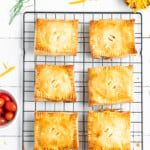
Finally, I use a pastry wheel to cut the dough into four separate tuna hand pies and crimp the edges of each tuna pocket pie to seal them shut.


As long as there isn't any egg wash on them, you can absolutely re-roll any scraps of dough. Gather any pastry dough scraps up into a ball. Flatten it out, wrap it tightly and let rest in the fridge before re-rolling. Each time you re-roll the dough, you're going to lose some flakiness. But it can definitely be reused!
Freeze the hand pies briefly before baking to chill the butter in the dough again. Immediately before baking, brush with egg wash, sprinkle with flaky salt, and use a sharp knife to cut vent holes in the top.


👩🏻🍳 Recipe Notes & Practical Tips
- If you're feeling intimidated by the puff pastry folding process, Erin McDowell has a really good video at Food52 showing how to do it. I know it seems like a lot of work but it's one of those things that's only difficult the first time you do it. Once you get the hang of it, it's really fun and meditative and really freaking cool!
- I like to use one of these large spherical ice cubes in my water when I'm making puff pastry. It melts slowly, keeps the water very cold, and also won't accidentally pour out of the container and get in my dough! If you do get ice cubes in your dough, just fish them out.
- To cut the pastry dough, I used my Norpro pastry/ravioli cutter which has two round wheels on it. One is a regular straight-bladed wheel like a small pizza cutter, the other has a fluted edge to make a scalloped edge also helps seal sheets of dough together.
- You can use a full size (8+ cup) food processor to do the first step of cutting the butter into the flour for the puff pastry. You'll still have to do the lamination — rolling and folding — by hand. My friend Cynthia has a really great quick and easy puff pastry recipe on her site that uses a food processor. You can use the measurements from my recipe but then follow the instructions for making the puff pastry from hers!
📖 Recipe
Tuna Melt Hand Pies with Puff Pastry
Recipe Notes
- If you don't want to make your own puff pastry, store bought will work fine. You'll need four sheets. Defrost in the fridge overnight before use.
- When working with puff pastry you always want to keep the butter as cold as possible. Try not to touch it with your hands too much. If at any point the dough seems too warm and malleable you can pause and stick it in the fridge to chill for 30 minutes before continuing.
- You can freeze unbaked hand pies pies after cutting the slit in them on a sheet pan. Transfer the frozen pies to an airtight container. Before baking, brush with egg wash and sprinkle with salt. You can bake them from frozen, but they may need an extra 5-10 minutes in the oven.
- For extra cheesy tuna melt hand pies, top the filling with additional shredded cheddar before you put the top layer of puff pastry down.
- It's hard to give a specific time for how long it takes to make the puff pastry; it depends on how often you chill the dough between folds, etc. I've estimated 4 hours assuming this is your first time making it, and that you might need to chill the dough more often than I do when I'm making it.
- This recipe was inspired by Erin Clarkson's (aka Cloudy Kitchen's) recipe for smoked salmon and cream cheese hand pies.
- If you're curious how the number and type of folds affects the final result, Nicola Lamb did a great visual breakdown in the Puff Pastry 101 issue of her Kitchen Projects newsletter.
- Store baked tuna melt hand pies in an airtight container in the fridge for up to one week. Eat cold or warmed. Do not store at room temperature. To reheat: 10 minutes at 300°F in your oven.
Ingredients
puff pastry
- 375 grams all-purpose flour (a little more than 3 cups)
- 225 grams unsalted butter (2 sticks, 16 TBSP)
- ½ teaspoon fine sea salt
- 1 cup water, with ice in it
- 30 grams apple cider vinegar (⅛ cup)
tuna filling
- 1 can tuna, drained (5.5 oz)
- ⅛ cup mayonnaise
- ¼ cup red onion (small dice)
- 1 stalk celery (small dice)
- ⅛ teaspoon paprika
- 1 teaspoon fine sea salt
- 3 cherry tomatoes
- 1 sprig fresh dill
- ½ cup cheddar cheese (grated on the large holes of a box grater)
- 1 pinch freshly cracked black pepper
egg wash & topping
- 1 egg
- 1 teaspoon water
- ¼ teaspoon salt
- 1 tablespoon flaky sea salt (optional, for topping)
Instructions
Rough Puff Pastry
- Prep your ingredients: Cut cold butter into chunks then let them chill in the fridge at least 10 minutes. Combine flour and salt in a large bowl. In a large measuring cup, combine water, ice, and vinegar. Set aside until butter has chilled.
- Cut in the butter: Add the chilled butter cubes to the flour and toss to coat. Working quickly so the butter doesn't melt too much, squish the butter cubes between your fingers, rubbing the flour into the butter. The goal here is just to flatten all the cubes and break them into slightly smaller pieces. It's ok if there are still some big chunks. Try not to handle the butter too much or it will start to melt.
- Mix the dough: Splash about ¼ cup of the ice water into the flour and butter mixture. Use your hands or a bowl scraper to gently mix the flour and butter around until the water is absorbed. Drizzle another ¼ cup of ice water directly onto the dry bits in the bowl and repeat the mixing process. Continue adding water 1-2 tablespoon at a time mixing until the dough holds together without crumbling when you squeeze it.The flour will have plenty of time to fully hydrate when the dough rests, so if you aren't sure, err on the side of a slightly drier dough.Dump the messy dough out onto a clean counter. Use a bench scraper to cut through the dough and redistribute the moisture if needed. Squeeze and pat the dough into a rectangle. Wrap in plastic wrap and let chill in the fridge for 1 hour.
- Do a double fold: On a clean surface lightly dusted with flour unwrap the chilled dough. Roll the dough into a long rectangle shape (I like to use a bench scraper to square it off as I go, but it doesn't have to be perfect). Move the rolling pin up and down but not side to side to keep the gluten strands moving in the same direction.Lift the dough occasionally to make sure it's not sticking; dust extra flour underneath if you need it.Dust any excess flour off the surface of the dough. Fold the top quarter of the dough down to the middle, fold the bottom quarter of the dough up to meet it. Then fold the top half down to hide the seam in the center. Rotate the dough 90 degrees.
- Do a single fold: Dust any excess flour off the surface of the dough. Roll the dough in another long rectangle, moving the rolling pin only up and down, not side to side. Fold the top third of the dough rectangle down. Then fold the bottom third up. Rotate the dough 90 degrees. Use your finger to make an indent in the bottom right corner of the dough so you know how to arrange the dough after it chills. Wrap the dough in plastic and chill for 30 minutes.
- Repeat: Remove the dough from the fridge. Arrange it so the corner with the indent is at the bottom right. Repeat the folding process — one double fold followed by one single fold. If you need to let the dough rest in the fridge for 30 minutes between each set of folds that's okay.
- After the final set of folds, wrap the dough tightly in plastic wrap and chill for several hours or overnight. It is now ready to be used and can be rolled in any direction.
Tuna Melt Hand Pie Filling
- Combine drained tuna, mayo, red onion, celery, dill, paprika, salt, and pepper in the bowl of a mini food processor. Run the food processor on the puree setting until the mixture is very smooth and creamy.
- Add the shredded cheddar and tomatoes and pulse just a few times to combine — you want bigger pieces of cheese to give that "tuna melt" vibe. Adjust salt and pepper to taste. Chill until ready to use (it will stay good in the fridge up to a week).
Assembly & Baking
- Remove chilled puff pastry dough from fridge. Divide in half. Wrap and refrigerate the dough you aren't using.Roll the puff pastry sheet to about ⅛" thickness. Use a bench scraper to square off the edges of the dough as you go, but it's ok if the edges are a little rough or misshapen. Trim the sheet to an 8x16" rectangle. Then divide the sheet in half so you have two 8x8" squares of puff pastry.
- Place one sheet on a lined sheet pan in the fridge to chill while you work with the other.
- Brush the egg wash along the outer edges of one 8x8" square of dough and through the center in both directions, creating a four section grid on the pastry. Spoon the chilled tuna filling into the center of each square, about 2 tablespoons each. Work quickly so the dough doesn't get too warm or sticky!
- Take the other 8x8" square of dough from the fridge and roll it slightly bigger in each direction. Gently drape it over the tuna melt filling. Start in the center of the dough and work outwards, pressing it down around the tuna filling, pushing out any air bubbles without squishing out any of the tuna. You should have about 1" of flat dough running around each of the tuna pockets.
- Use a pizza cutter to divide the square into quarters, separating the tuna hand pies. Crimp the edges of each tuna hand pie with a fork to seal them together. Trim away any excess dough around the edges.
- Place the four tuna hand pies on a silicone or parchment lined sheet pan and chill in the freezer for 30-40 minutes before baking. Repeat with the remaining dough and tuna filling.
- Preheat oven to 375°F while the hand pies are in the freezer. Right before baking, cut two slits in the surface of the pastry (be careful not to cut into the bottom sheet of dough!), brush the hand pies with an egg wash and top with flaky salt.
- Bake for 25-35 minutes until golden brown and flaky. Remove from the oven and let cool on a wire rack. Serve warm, room temp, or right out of the fridge. Store extras in an airtight container in the fridge for up to a week.
Comments
No Comments