

This overnight focaccia has a super crisp bottom and pillowy, airy top. It's so easy and hands off to make and can be used for dipping in oil or sliced for sandwiches! With an 8 to 12 hour rise time, you can start this focaccia recipe at night and bake it in the morning, or start it in the morning and bake it at night.
Top it with fresh herbs, cheese, or vegetables — you can really get creative! I also love using this dough to make my super-popular thick focaccia pizza!

5 STAR READER REVIEW
“This was by far the best pay off I have ever had from a bread recipe. 15 minutes of hands on work plus rise time and you have perfect focaccia for sandwiches for dinner. This will be in a weekly rotation for super easy dinners.”
—Beth
This overnight focaccia is actually a full-size version of my Small Batch Focaccia. If you're looking for a fast focaccia, check out my Thin & Crispy Ligurian Focaccia, which can be done in just two hours.
While there is certainly no shortage of focaccia recipes in the world, my goal in developing my overnight focaccia recipe was to keep everything as simple as possible.
That also meant minimizing the amount of work required to build strength in the dough before letting it rise. So this is a no-knead overnight focaccia; you don't need a mixer to make it.
A lot of other no-knead focaccia recipes require several sets of folds over a long (or long-ish) period of time, or require a mixer to get going. My overnight focaccia recipe needs just two sets of folds in a 20 minute period. Then it goes right into the pan it bakes in, and is hands-off until it's time to bake.
So if you're looking for a basic, beginner-friendly focaccia recipe, my overnight focaccia is exactly what you're looking for.

I tested a batch of this focaccia without any sugar, and it just would not brown on top, and the bottom was soggy instead of crisp — so don't skip the sugar! You do need it. Honey will also work.
Focaccia is an oil-heavy bread, so I always use a high-quality olive oil with a flavor I really like because I know I'll be able to taste it in the final bread. I recently made my focaccia using Brightland's Aurora Rosemary olive oil (use code PRACTICAL for 15% off), and was delighted by how nicely it amped up the fresh rosemary flavor.
This is an Easy No-Knead Dough


To build strength into my focaccia dough, I do two sets of folds during the first 20 minutes after mixing.
During the second set of folds, you'll notice the dough is stronger, smoother, and stretchier. It just needed a bit of time to rest. Resting builds strength — remember that! (It applies to humans, too!)


Spray your baking pan with non-stick spray. Then drizzle olive oil into the center of the pan and tilt the pan so the oil spreads out. (This is a tip I picked up from King Arthur Baking — the non-stick spray prevents sticking, but the oil is what will give you that crispy bottom!)
After an overnight rest at room temperature, the focaccia dough will have spread out into the corners of the pan. It will look airy and bubbly and should jiggle slightly when you shake the pan.
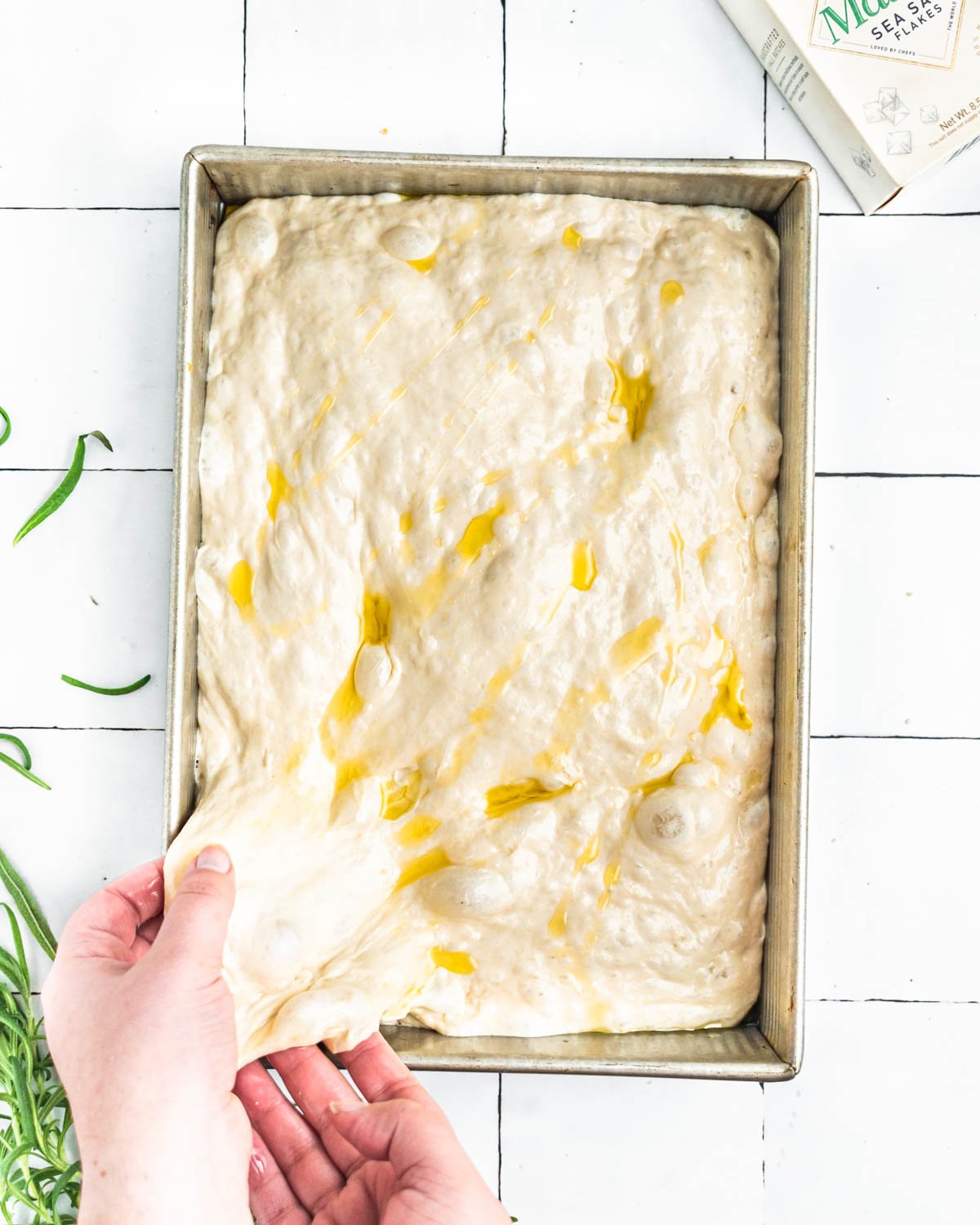
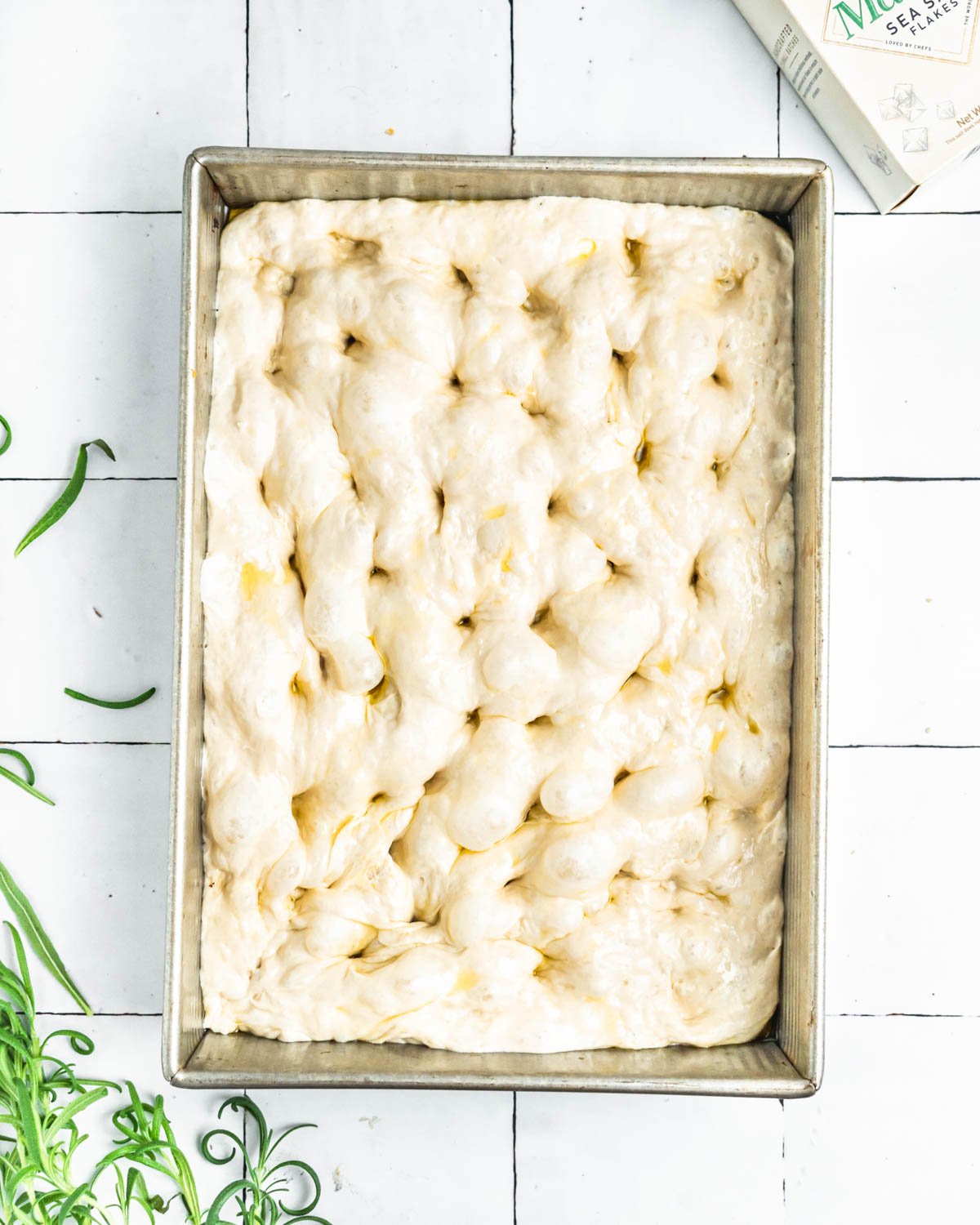
Thirty minutes before you plan to bake, drizzle the top with more olive oil. Use your oiled fingers to dimple the dough from top to bottom, pressing straight down until your fingers touch the bottom of the pan.
Top the focaccia with any fresh herbs you like — here I used fresh rosemary — and sprinkle with flaky sea salt.
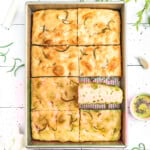
When it's done baking, the focaccia will be golden brown on top and will have pulled away slightly from the sides of the pan. If you slide a spatula under it (gently!) it should lift in one piece and the bottom will be dark golden brown and crispy.


9x13" Rectangular Baking Pan
Dimensions: 9 x 13 x 2.25 inches. A high-sided rectangular metal baking pan with a durable, environmentally friendly non-stick coating. Particularly appreciated for its precise 90° corners and edges. Max temperature: 450°F.

Just remember...
Relax and enjoy the process! Focaccia is a low-effort bread that is very hard to mess up. Time will do most of the work for you. Don't agonize over it too much. If your focaccia looks ready to bake, get dimpling! If it looks like it needs more time, give it more time to rise. You got this!
💭 Have More Baking Questions?
I've rounded up answers to common baking questions and how-to guides, including:
- Ingredient swaps and FAQs
- Why my recipes are written in grams and not cups
- How to quickly bring eggs and butter to room temperature
- Ingredients I use (salt, flour, yeast, etc.)
- Step-by-step guides for bread and baking techniques
See my baking techniques & troubleshooting guide and ingredient swaps and FAQs for more!
📖 Recipe
Thick and Fluffy Overnight Focaccia (Beginner-Friendly!)
Recipe Notes
- Focaccia is best served same day, but if you do need to save it for later you can always freeze it. To freeze: Cool completely, then wrap well and freeze. You can freeze it as one big piece, but I recommend freezing it in thinner slices or squares (wrapped individually, then stored in a large freezer bag). Defrost on your counter, then reheat in a 375°F oven until warmed through.
- Focaccia is best served immediately, or within 12 hours of baking. After 12 hours the salt will start to dissolve and absorb into the dough, and the bread will start to dry out and become oily.
- For an extra crisp bottom: Pre-heat a baking steel or baking stone in the oven and slide the sheet pan right onto the steel to bake!
- Cold proofing in the fridge: The nice thing about a fridge rise is that it happens so slowly you have a nice long window of time in which your focaccia will be ready to bake. The longest I'd say you can leave it in the fridge before baking is about 48 hours. It's hard to put a specific time to how long it will need to continue proofing at room temperature once you take it out of the fridge though, so you'll just have to use your eyes. When it fills the pan and looks quite bubbly and airy, you're ready to start dimpling and topping.
Ingredients
- 480 grams all-purpose flour
- 14 grams sugar
- 10 grams diamond crystal kosher salt
- 2 grams instant yeast (⅔ teaspoon)
- 390 grams warm water (90°F)
- 40 grams olive oil
For topping
- 3 tablespoons olive oil (divided)
- 1 sprig fresh rosemary
- 1 teaspoon flaky sea salt
- ¼ teaspoon freshly cracked black pepper
- 1 tablespoon everything bagel seasoning blend (optional)
Instructions
- Combine flour, sugar, salt, and yeast in a large mixing bowl. Pour warm water and olive oil directly into the center of the dry ingredients. Mix with a dough whisk or spatula until completely combined. The dough will be sticky and very messy. With a damp hand grab a corner of the dough and stretch it over itself. Rotate the bowl and repeat to gather the dough in a loose ball in the center. Cover and rest 5 minutes.
- Dampen your hands and repeat the folding process, grabbing a corner of the dough, stretching it away and then down over the center of the dough. Rotate the bowl and repeat with each side of the dough.Cover and rest 15 minutes.
- While the dough rests, spray a 9x13" high-sided baking pan with non-stick spray, making sure to get the sides too. Drizzle 1 tablespoon oil in the center, and tilt the pan to spread the oil out.
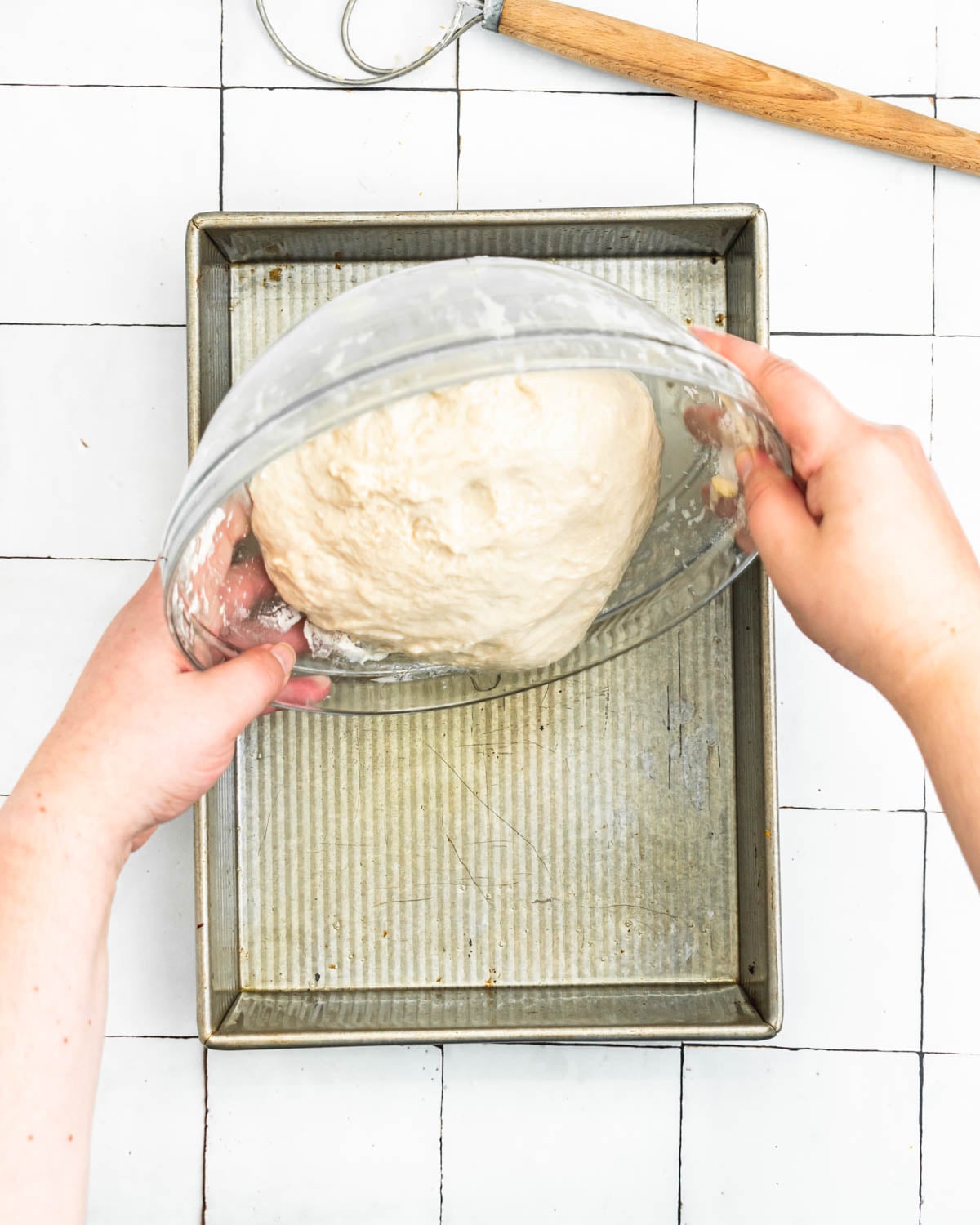
- Repeat the folding process one more time. The dough should be much smoother, stronger, and stretchier this time. On the final fold, flip the dough over so the seam side is down. Then slide the folded dough out of the bowl and into the oiled baking pan.Cover and rest 8-12 hours at room temperature.
- An hour before you plan to bake the focaccia, preheat the oven to 400°F. The focaccia should have relaxed and filled out the pan and look bubbly and jiggle slightly if you shake the pan. If it hasn't filled out the pan, use oiled fingers to gently lift and stretch the dough into the corners. Cover and place the pan on top of the stove while the oven preheats. The ambient warmth will give the yeast one last boost before baking.
- 30 minutes before baking, top and dimple the focaccia. Drizzle 2 tablespoons olive oil over the surface of the focaccia. Use your fingers to gently rub it around, then poke your fingers straight down until they hit the bottom of the pan. Repeat this all over the dough. Finish with fresh rosemary, herbs, freshly cracked black pepper, and a sprinkle of flaky sea salt. Cover and let rise until ready to bake.
- Bake. Bake the focaccia for 20-25 minutes until golden brown on top. If it browns unevenly, rotate the pan after 20 minutes and bake a few minutes more. Remove from the oven and immediately drizzle with 1 tablespoon olive oil. Let cool in the pan 5-10 minutes, then remove to a cooling rack. Cool completely (or almost completely) before serving.
Kalene says
LOVE this recipe. It comes out perfect every time. Using a scale has changed my baking! I started with the 1 cup focaccia to see how it went (perfect!) and then scaled up to this one. Have made it probably 5 times in the last two weeks. If we have any leftovers after dinner we make breakfast sandwiches! I’ve made this plain (no toppings) and fully loaded for breakfast (sausage, potatoes, egg, cheese, peppers) and it comes out great every time!
Rebecca Eisenberg says
Yum!!! That sounds so good, and I love all those toppings! Thanks for being part of Team Kitchen Scale! Happy baking ~R
Gloria Denise says
When you say to cover the focaccia pan, is it with a dish towel or plastic?
Rebecca Eisenberg says
I recommend plastic for this since it's such a long rise! If you use something that allows air through like a towel the focaccia might dry out on top.
Stephanie says
I’ve made this several times and love it! I really appreciate how well written the instructions are so I always feel confident in what I’m doing. I also highly recommend using the oil from a sun dried tomatoes jar if you didn’t check how much olive oil you have left before starting the recipe lol. It tasted amazing!
Lisa says
I've made this focaccia twice, and both times the bread has been perfect. The recipe is spot on. Thanks again for another great recipe! Btw ... I topped mine with fresh garlic, finely minced, chopped rosemary, and after sprinkling of kosher salt ... delicious! Next time, I plan to try some sun-dried tomatoes as well.
Dan Donovan says
About the fifth time I’ve made this now. I pretty much just follow the recipe as written since the results are so dang good.
Julie Worrell says
Hu. I’ve made the mini pan focaccia and it’s fab. I was wanting to go larger and wondered why this recipe has so much less yeast than the mini focaccia sized up x 3? Thanks
Rebecca Eisenberg says
The amount of yeast affects how fast a dough rises. This is a no-knead focaccia that uses a long rise time to develop strength and structure. The smaller one is designed to be done faster so it has more yeast in it to help encourage that faster rise time.
Julie Worrell says
Thanks so much, that’s really helpful. I love all your bread recipes but usually just make the mini versions which always turn out perfectly! X
Maya Jane Satwant says
Made this with yeast and loved it! Possible to substitute it with sourdough starter?
Rebecca Eisenberg says
I haven't personally tried it but you could give it a go!
Kim says
Please help....I've committed myself to making 14 loaves of focaccia despite the fact that I've never made focaccia in my life :/ I've read both this recipe and your small batch/loaf recipe for focaccia and I'm convinced that if any recipe is going to get me across the finish line with good results, it's going to be this one (or the small batch one). But a couple of questions...
1) Do you think I can divide this recipe in 4 loaf plans (this recipe has the equivalent of ~4 cups of flour and the small batch ~1 cup) and bake as the small batch describes?
2) Do you think I can double, triple or even quadruple this recipe and make in one large batch? Or would you advise that I make several individual batches of this recipe? [based on a comment I read in the other recipe about yeast I think the better approach is to divide this recipe, rather then double, triple, etc the small batch recipe]
Any help or advice you can provide would be GREATLY appreciated. Thank you 🙂
Rebecca Eisenberg says
Hi! Wow, that's a lot to take on! I would definitely recommend using this recipe rather than the small batch one. And yes, you can divide this one into four loaf pans, that's for sure the way to go. And you can double/triple/quadruple this recipe, but you'll need a pretty large bowl or bucket — it might be best to do two double batches of this dough, if you have bowls big enough to handle it! Hope this helps!
Kim Rhodes says
Thanks so much for the reply! Fingers and toes crossed... I’ll let you know how it turns out!
Amanda says
Can I use a glass 9x13 Pyrex type pan?
Rebecca Eisenberg says
You can, but I don't recommend it if you want a really crispy bottom!
Amanda says
Thank you, I already have so much different cooking stuff, I didn't want to include another pan. 🤷♀️ Guess we'll see how she turns out in a glass pyrex.