

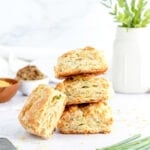
This small batch recipe for roasted garlic and cheddar biscuits is packed with flavor thanks to lots of roasted garlic, chives, and buttery, flaky layers created by a compound butter laminated into the dough.
They take just a few minutes to make and are even better when made with homemade stand mixer butter and buttermilk.

When I got really into making homemade butter a couple of months ago, it was basically inevitable that flavored butters would follow. Follow they did — mostly in the form of this roasted garlic and chive herb compound butter which is so good under the skin when roasting chicken and turkey.
So what’s a person to do with lots and lots of homemade compound butter and fresh, homemade buttermilk? BISCUITS, BABY. Garlic butter biscuits with lots of herbs!
Biscuits are best eaten while still warm from the oven, so I always love a good small-batch biscuit recipe. This recipe makes just 4 medium-sized garlic cheddar chive biscuits.
Garlic cheddar biscuits are a great sub for garlic bread with my nostalgic spaghetti and meatballs if you don't have time to make garlic bread or knots, but are also so delish on their own with salted butter.

Use pastry flour for the most tender biscuits
I use King Arthur Baking's pastry flour blend to make these flaky small batch biscuits. Your biscuits will be flakier and more tender with a pastry flour, but all-purpose flour will also work if that's all you've got.
Roasted Garlic Chive Compound Herb Butter - The full version of this compound butter recipe makes about 200 grams (7 ounces) butter. You only need 60 grams of compound butter for this recipe. Make the roasted garlic and chive herb compound butter in advance so that it has time to chill completely in the fridge. You always want to work with VERY COLD (but not frozen) butter when you’re making biscuits.
Buttermilk - If you're using homemade buttermilk, it will be thinner and a bit sweeter than the cultured buttermilk you get in stores. I've made these garlic butter biscuits with both homemade and cultured buttermilk and didn't notice too much of a difference between them! Keep chilled until ready to use.
How to get flaky biscuit layers
The reason it's so important to keep the butter and buttermilk for biscuit dough as cold as possible (without freezing it) is to get nice, flaky biscuits. Cold butter turns into steam in the oven and pushes the layers of dough apart, creating those flaky layers. If the butter is too warm, it will melt out of the biscuits in the oven.
To make these flaky biscuits you’re going to build those layers of butter in two ways: The first way is a pastry technique called sabler (sab-lay), which involves pinching, smushing, and rubbing the flour into the dry ingredients. It's very easy, fun, and fast! The second way borrows from a technique called lamination, which involves layering the dough to create flat layers of butter before you cut it.
![[gif] pinching butter into flour](https://thepracticalkitchen.com/wp-content/uploads/2021/09/mini-honey-butter-biscuits-7759.jpg)
![[gif] showing pea-sized butter flakes in dry ingredients](https://thepracticalkitchen.com/wp-content/uploads/2021/09/mini-honey-butter-biscuits-7765.jpg)
Once the butter pieces are about nickel-sized, gently fold in the cold buttermilk just until everything is mostly combined. It’s okay — ideal, even! — if there are still lots of dry bits in the bowl.
As long as there’s no buttermilk pooling in the bowl and it’s mostly been absorbed in, STOP MIXING. Do not pass go, do not collect $200, etc, etc.
Then you do the second kind of butter layering through a quick series of folds. The dough will be messy at first, but after the second fold it will start holding together just fine.
![[gif] scraping messy dough out onto cutting board](https://thepracticalkitchen.com/wp-content/uploads/2021/09/garlic_cheddar_buscuits_7.gif)
![[gif] cutting butter into dough on the counter](https://thepracticalkitchen.com/wp-content/uploads/2021/09/garlic_cheddar_buscuits_8.gif)
![[gif] pat the messy dough into a rectangle](https://thepracticalkitchen.com/wp-content/uploads/2021/09/garlic_cheddar_buscuits_3.gif)
![[gif] fold down the top third of dough](https://thepracticalkitchen.com/wp-content/uploads/2021/09/garlic_cheddar_buscuits_4.gif)
![[gif] fold up the bottom third of dough](https://thepracticalkitchen.com/wp-content/uploads/2021/09/garlic_cheddar_buscuits_5.gif)
![[gif] rotate the folded dough packet 90 degrees](https://thepracticalkitchen.com/wp-content/uploads/2021/09/garlic_cheddar_buscuits_6.gif)
Here's how it works: Turn the whole damp mess of flour and butter out onto a clean, lightly floured surface. Cut across it in a cross hatch pattern to cut through any remaining chunks of butter and help redistribute the moisture in the dough. Use your hands and a bench scraper to pat it into a long rectangle shape about ½” high.
Do a letter fold: Slide the bench scraper under the top third of the dough rectangle and fold it down. Then do the same with the bottom third of dough, folding it up over the top fold. This is called a “letter fold" because it's how you fold paper when you mail a letter.
Slide the bench scraper under the folded dough packet and rotate it 90 degrees. Repeat the letter fold again, finishing by rotating the dough packet 90 degrees. This time, after you rotate it, the dough will be much more cohesive and smooth.
Pat the dough packet out into a 5-inch by 5-inch square shape about 1” tall. Trim the absolute least amount you can off all four sides to release the tension from where the dough was folded so the layers can rise evenly. Pat the excess dough down on top of the biscuit square.
Clean off the edge of your bench scraper so it’s nice and sharp. Then cut the square into four equal pieces. That’s it! Those are your biscuits!


Place on a sheet pan, brush the tops with egg wash, sprinkle with flaky sea salt, and they're ready to bake.
Practical Tips and Recipe Notes
- To make just enough compound butter for these garlic butter biscuits you'll need: 4 tablespoons unsalted butter, 2 cloves roasted garlic, 2 tablespoons chopped chives. 1 teaspoon additional minced herbs like rosemary, thyme, or sage optional.
- Always cut and trim the biscuit dough by moving your knife or cutter in an up and down motion. If you slide it in a slicing motion along the counter you’ll close up all the outside layers and your biscuits will be flat.
- I use Maldon flaky sea salt to top my biscuits, but any flaky finishing salt is fine.
- If you don't want your hands to smell like roasted garlic, you may want to wear kitchen gloves while pinching the butter into the flour.
- You can freeze your shaped biscuits on a sheet pan and then transfer them to an airtight container to store in the freezer. Egg wash prior to baking. And add a few minutes to the bake time to account for the colder starting temperature.

💭 Have More Baking Questions?
I've rounded up answers to common baking questions and how-to guides, including:
- Ingredient swaps and FAQs
- Why my recipes are written in grams and not cups
- How to quickly bring eggs and butter to room temperature
- Ingredients I use (salt, flour, yeast, etc.)
- Step-by-step guides for bread and baking techniques
See my baking techniques & troubleshooting guide and ingredient swaps and FAQs for more!
📖 Recipe
Garlic Cheddar Biscuits
Recipe Notes
- Always cut and trim the biscuit dough by moving your knife or cutter in an up and down motion. If you slide it in a slicing motion along the counter you’ll close up all the outside layers and your biscuits will be flat.
- Keep your biscuit ingredients as COLD as possible. If it’s particularly hot or humid in your kitchen, you can even chill the dry ingredients before (or after) you pinch in the butter. Once you add the buttermilk the clock is ticking — work quickly to laminate and shape the dough.
- DO NOT OVERMIX your biscuit dough. Once you add the buttermilk you just want to fold it gently together just until no liquid remains. The flour will continue hydrating and absorbing the buttermilk as you work through the lamination process. At first it might not seem like it will hold together, but by the time you do the final fold, the dough will hold together just fine.
- You can freeze your shaped biscuits on a sheet pan and then transfer them to an airtight container to store in the freezer. Egg wash prior to baking. And add a few minutes to the bake time to account for the colder starting temperature.
Ingredients
- 180 grams pastry flour
- 110 grams cold buttermilk (homemade preferred)
- 60 grams roasted garlic chive herb compound butter (very cold)
- 40 grams cheddar cheese (finely grated)
- 2 teaspoon baking powder
- ½ teaspoon diamond crystal kosher salt
- 1 egg (for egg wash)
- 1 teaspoon flaky sea salt (for topping)
Instructions
- Preheat oven to 400°F.
- Cut butter into 1" pieces and chill well in the fridge. Measure buttermilk and place in the fridge. Leave both in fridge right up until ready to use to keep them as cold as possible.
- Combine pastry flour, salt, baking powder, and cheddar cheese in a medium mixing bowl. Toss well to combine and coat cheese in flour.
- Add butter cubes to dry ingredients and toss to coat. Pinch and rub butter pieces into the flour between your finger tips until they're the size of small grapes. Work quickly so the warmth of your fingers doesn't start to melt the butter.
- Add cold buttermilk and fold gently with a spatula just until combined. It's okay if there's still some dry floury bits left in the bowl.
- Turn dough out onto lightly floured countertop or cutting board. Use your hands to roughly shape the mixture into a flat rectangle shape. Then use a bench scraper to cut through the dough in a cross hatch pattern.It won't hold together yet, that's okay.
- Gather the dough into a rough rectangle about ½" tall. Use the bench scraper to fold the rectangle in thirds like a letter.Then slide the bench scraper under the dough packet, lift it up, and rotate it 90 degrees on the counter.
- Flatten the dough rectangle out again so it's about ½" tall and longer than it is wide. Use the bench scraper to straighten the sides and ends of the rectangle as best you can. Repeat the letter fold process and rotate the dough 90 degrees again.The dough should be holding together much better at this point.
- Flatten the dough out into a 5x5" square about 1" tall. Use the bench scraper in an up-and-down motion (don't saw or slice) to trim the edges (remove as little as you can) all the way around so you have a sharp square and can see the layers inside.
- Press the scraps gently into the top of the dough square, then divide the dough into four equal sized pieces, again using the bench scraper in an up-and-down motion.
- Transfer biscuits to lined sheet pan and brush just the tops with egg wash. Sprinkle with flaky salt. If the dough seems to be getting soft or warm, place in the fridge for 10-15 minutes prior to baking.
- Bake for 20-22 minutes at 400°F until shiny and golden brown on top.
IR says
I made these! So delicious and easy! There's something so approachable about these small batch recipes. I was able to casually serve one to my girlfriend on Valentine's Day and she was very impressed 🙂
Rebecca Eisenberg says
I'm so glad you liked it and that your girlfriend was impressed by it! 🙂
DS says
Could you cook these in an air fryer? If so, what would you suggest for the temperature and time?
Rebecca Eisenberg says
I don’t have an air fryer so I’m not sure, sorry!
Megan says
This recipe is great! It came together pretty quickly and turned out so yummy! Directions were easy to follow but the pictures were a helpful addition. Love that they're small batch, will become a part of the dinner rotation for sure!