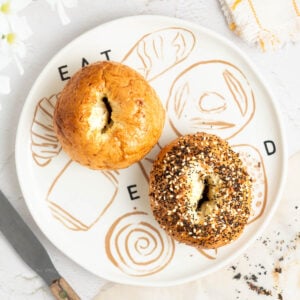
Small Batch Bagels Recipe (Makes Just 2 Bagels!)
People are so scared to try making bagels from scratch, but once you give this easy recipe a try, you’ll be hooked. Bagels are made from a low-hydration dough that’s fun to work with, and while this isn’t a “traditional” bagel recipe that uses barley malt syrup and bread flour, it’s great for beginners. When you see how the dough transforms after boiling and baking it’ll feel like you’ve done a magic trick! Just in time for breakfast, too.
Ingredients
- 120 grams all-purpose flour (1 cup, loosely scooped and leveled)
- 4 grams sugar (1 teaspoon)
- 3 grams diamond crystal kosher salt (1 teaspoon; use half as much of any other brand of salt)
- 1 gram instant yeast (heaping ¼ teaspoon)
- 72 grams water (¼ cup + 2¼ teaspoons, 90°F)
- 1 large egg (beaten well, for the egg wash)
- 2 tablespoons bagel toppings (optional)
Instructions
- Mix. In a medium bowl, whisk together the dry ingredients. Make a well in the center and add the warm water. Use a dough whisk or a fork to mix until the water is incorporated and the dough comes together in one shaggy mass, then switch to a bowl scraper or your hand and fold the dough over itself just until it comes together. There might be a few dry bits left in the bowl and that’s okay.
- Knead. On a lightly floured surface, knead the dough until smooth and slightly tacky to the touch, 5 to 6 minutes. Lightly dust with flour only as needed, just to prevent sticking.
- First rise. Lightly grease the bowl with cooking spray. Shape the dough into a ball, return it to the greased bowl, cover, and let it rest somewhere warm until it doubles in size and passes the Fingerprint Test (page 20), 1 to 1½ hours.
- Preheat. Toward the end of the rise time, line a sheet pan with parchment paper and preheat the oven to 425°F. Fill a wide medium pot with at least 2 inches of water and bring to a low boil.
- Shape. While the water comes to a boil, divide the dough in half using a bench scraper (each half should weigh about 100 grams). Shape each half into a tight ball with a pinched-together seam underneath. Push your thumb gently through the pinched-together seam at the bottom of the dough ball. (This pushes all those edges together and gives the bagel a cleaner, neater look.) Gently insert your other thumb and begin squeezing and stretching as you rotate the bagel in your hands to gradually widen the hole until it’s about 2 inches across.
- Second rise. Place the bagels on the prepared sheet pan, cover with a damp paper towel, and let them rest for 10 minutes.
- Boil. Give each bagel a quick final stretch following the same technique from photo 2 (to prevent the holes from closing up). Place the bagels in the water, top-side down. Boil for 1 minute, then use a spider skimmer to flip them and boil for 1 minute more. Use the spider skimmer to remove the bagels from the pot and slide them back onto the parchment-lined sheet pan.
- Bake. Brush the bagels lightly with the egg wash and sprinkle with any desired toppings. Bake until golden brown and shiny on top, 18 to 20 minutes. Transfer to a wire rack and let cool slightly before eating.
For more detailed step-by-step visual instructions for how to shape bagels, check out my bagel-making 101 guide.
RECIPE NOTES
- If you are measuring with cups, it is super important that you measure the ingredients properly. See my guide to measuring as accurately as possible by volume for how to do this. If you measure with cups/teaspoons and the recipe did not turn out right, that is likely why. Try again!
- If you want to use bread flour, you'll need to add a bit more water to the dough, since bread flour is more absorbent than all-purpose flour. Add it gradually, about ¼ teaspoon at a time, so you don't accidentally add too much.
- The egg is there for an egg wash; it gives the bagels a shiny crust and helps the toppings stick. You can absolutely make these homemade bagels without egg if you prefer.
- One of the biggest mistakes you can make with bagel dough is not kneading it long enough, so I do recommend setting a timer to keep yourself honest.