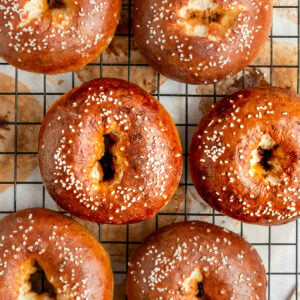
Easy Homemade Pretzel Bagels
These pretzel bagels are the best of both worlds — deeply browned, salty pretzel exterior with a chewy, dense bagel interior.
Ingredients
Pretzel bagel dough
- 500 grams all-purpose flour
- 28 grams brown sugar (2 tablespoons, packed)
- 8 grams diamond crystal kosher salt
- 6 grams instant yeast (2 teaspoons)
- 275 grams water (90°F)
- 28 grams unsalted butter, melted (2 tablespoons)
- 1-2 teaspoons pretzel salt (for finishing)
Baking Soda Solution
- 150 grams baking soda (a heaping ½ cup)
- 5 cups water (1.2 kilograms)
Instructions
- Preheat oven to 300°F.
- Prep baking soda. Spread the baking soda on a sheet pan and set aside.
- Mix. In the bowl of a stand mixer, whisk together the dry ingredients: flour, brown sugar, salt, and yeast. In a separate bowl or measuring cup, whisk the salt into the water until dissolved. Make a well in the center of the dry ingredients and pour in the water and melted butter. Use the dough hook attachment to mix on low speed until the dough comes together in a shaggy, messy ball. You may need too pause and scrape down the sides of the bowl a few times. Be patient, this can take several minutes.
- Knead. Increase the speed of your mixer to medium-low and knead the dough until it's smooth, supple, and just slightly tacky (but not sticky) to the touch, about 2-4 minutes. If the dough is clinging to the sides or bottom of the bowl, dust in more flour 1 tablespoon at a time until the dough fully pulls away from the sides.
- Rise. Tuck the dough into a ball, place in a lightly greased bowl (you can use your mixer bowl), cover, and let it rise in a warm spot until doubled in size, about 1 hour.
- Bake the baking soda. Place the sheet of baking soda in the oven for 1 hour. The baking soda needs to bake for an hour and the dough needs to rise for an hour, so use the same hour to get both things done.
- Pre-shape. Turn the dough out onto a clean, un-floured work surface and gently deflate it with your fingers. Divide the dough into 8 equal pieces, using a kitchen scale to be precise (each piece should be about 105 grams).To shape the dough into rounds, gently flatten a piece of dough against the counter. If you're combining multiple pieces of dough, stack the smaller pieces on top of the biggest piece to tuck them inside. Fold all the edges of the dough into the middle so you have a nice smooth, taught surface against the counter and the pinched together "seam" side facing up.Flip the dough over so the smooth side is up. Cup your hand gently around it with your pinkie against the counter. Slide your hand toward your body to pull the dough ball closer to you without rolling it. This will increase the surface tension on top of the dough and shape it into an oval. Rotate the dough 90° and repeat the sliding motion to turn the oval into a circle. Pinch the seam together at the bottom again to finish.Repeat with the rest of the dough. Cover the dough balls with a damp paper towel and let them rest for 10 minutes.
- Preheat oven to 420°F with an oven rack in the middle position.
- Shape. Dust the bottom of each dough ball with flour and use your thumb to poke a hole through the bottom seam of each dough ball and out the other side. Rotate the dough through your hands as you squeeze it to stretch the bagels out. You want the dough to stretch, not tear. The holes should be fairly large — twice the width of the bagel sides. Arrange the shaped bagels on a parchment-lined sheet pan and cover with a damp paper towel. Refrigerate for 10-30 minutes.
- Prep the water bath. While the bagels are in the fridge, fill a large, high-sided saute pan with about 2-3 inches of water. Bring it to a low boil or active simmer on the stove. In a separate bowl, combine 5 cups of cool water with the baked baking soda. Whisk well to make sure all the baking soda has dissolved.
- Boil and dip. Working in batches of 2 or 4, boil the bagels 45-60 seconds per side. Then use a wire spider to transfer the boiled bagels directly into the cool baking soda bath, and submerge for 10-15 seconds. Use the wire spider to transfer the pretzel bagels back onto the sheet pan.
- Bake. Sprinkle the pretzel bagels generously with pretzel salt. Bake for 20 minutes until deeply browned and shiny. Let bagels rest for 5-10 minutes on the sheet pan, then transfer to a wire cooling rack to finish cooling completely before eating.
The butter in the pretzel bagel dough makes them a little stretchier to work with, so make sure your dough balls feel really tight and smooth before you poke the holes through.
RECIPE NOTES
- Pretzel bagels are best eaten within 8-10 hours of baking. The salt on top begins to draw moisture out of the bagels, drying them out pretty quickly. If you don't plan on eating the bagels right away, consider freezing them.
- Measure your baking soda by weight before you bake it. It loses 30% of its weight when you bake it so if you weigh it after it bakes you'll have way too much baking soda in your water bath.
- Make sure the baking soda is fully dissolved in the water bath before you dip the boiled bagels in it. If there are lots of clumps or the baking soda hasn't dissolved, your bagels might end up tasting soapy.
- If you don't have a mixer with a dough hook, follow the same instructions, just start mixing the dough in a bowl and then knead it on a lightly floured surface by hand for 8-10 minutes once the dough comes together.
- Baked baking soda loses up to 30% of its weight in the baking process. The amount of baking soda listed in the recipe is for the amount you need before it's baked. If you want to, you can bake the baking soda in advance and store it in an airtight container until you're ready to make your pretzel bagels.